If you’re here, my writing means something to you — and that means something to me.
So, you get something special. Aside from my editors and endorsers, including Temple Grandin, today you are among the very first people to read an excerpt from my upcoming book, The Misunderstood Mind: What We Got Wrong About Autism, ADHD, and Neurodivergence.
And…
If you’d like to read the entire book before it is released, I’m looking for a small group of advance readers. All I ask is that you be willing to leave an honest Amazon review when the book launches.
So, if you’d like to join the launch team, sign up below, and I’ll send you the complete PDF. Spots are limited!
Many of you have been following my work for years. You have read my articles, listened to my podcast, attended my trainings, trusted me with your stories, and helped build this community. It felt right that you would be the first to see what I have been working on.
Whether you’re neurodivergent yourself, love someone who is, or work with neurodivergent individuals, this book was written for you.
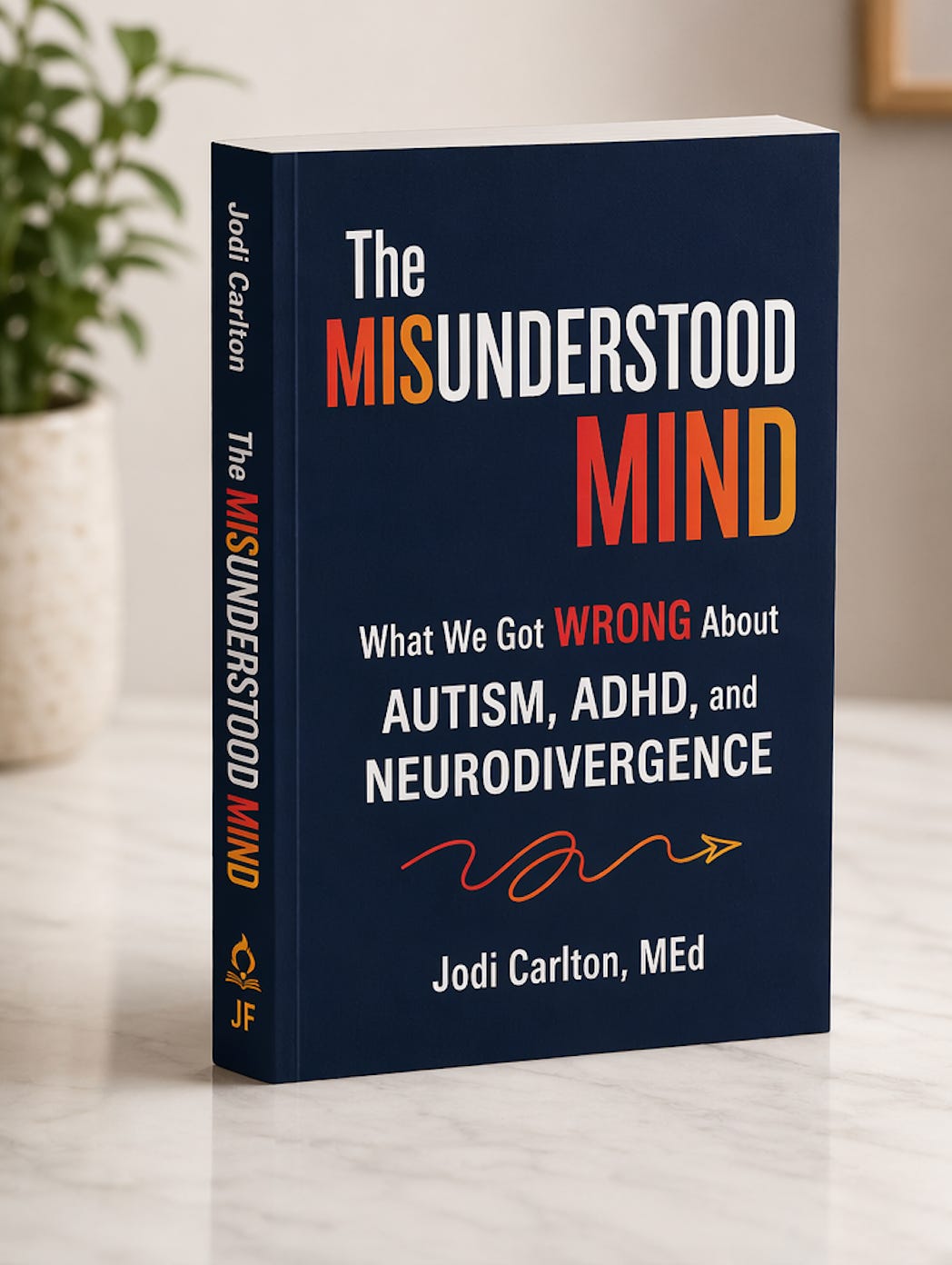
So, before pre-orders open in late July, and before the book arrives on Amazon on October 7, here is the first-ever peek inside The Misunderstood Mind:
Excerpt:
INTRODUCTION
While researching this book, I was shocked to learn that, in some medical settings, infants once underwent surgery without anesthesia. This practice persisted into the 1980s, when I was a teenager, alongside the appearance of MRIs and robotic surgery in our modern hospitals. As a mother, I wondered how something that felt barbaric could have been accepted by educated, respected physicians.
The explanation was not that doctors lacked compassion. It was that they were working from the scientific understanding available to them. At the time, physicians thought infants’ nervous systems were too underdeveloped to feel pain. Performing surgery without anesthesia made sense within the framework they had been taught.
As a clinician trained in research methods, I understand that we build frameworks from the best evidence we have and revise them when new information emerges. That is how progress happens. Science moves forward because we are willing to discover where we were wrong.
Yet, what feels unthinkable now, we once considered responsible, informed care.
Thankfully, the belief that infants cannot experience pain was challenged by research and has been disproven. Still, it is not beneficial to criticize the physicians who performed procedures without anesthesia (Anand & Hickey, 1987). They were not being cruel. They were performing life-saving surgeries and procedures on infants who might otherwise have never made it to their first day of school. Many parents are grateful to these physicians who gifted their children with life.
Even understanding all of that, one question stayed with me:
How could we have ever believed that?
Reflecting on that singular question, the connection to neurodivergence was suddenly clear to me. Other questions that had been swirling around in my mind for quite some time rose, again, to the surface of my thoughts.
What if our ideas about what is normal, what is flawed, and what is disordered are rooted in an incomplete understanding of ourselves as human beings?
What if future generations look back at us and ask:
How did they ever think that?
We like to think we are immune to those kinds of mistakes now, but every generation has its own set of assumptions. Many people rarely stop to question their beliefs about how they think, feel, perceive, and relate. These beliefs become so embedded in families, schools, communities, and culture that they feel like common sense. They feel like facts.
In my work with couples, one partner often says, “Everybody knows [that],” or insists, “[That] is just what you do when you love someone.”
For example, many people assume that loving someone means naturally anticipating their needs, remembering what matters to them, or expressing care in familiar ways. As a relationship specialist, I can tell you that many people love deeply and wholeheartedly while struggling with these exact skills.
There is a widespread belief that healthy emotional awareness, communication, and responsiveness should look roughly the same from person to person.
Most of us carry around a long, invisible list of things we think we should do.
People should recognize how others feel without needing it explained.
People should know how to behave in social situations.
People should make eye contact, notice tone, and read body language naturally.
People should stay organized, focused, and productive.
People should remember important details and responsibilities.When someone consistently struggles with these expectations, we tend to think something is wrong with their attitude, effort, maturity, or character, instead of considering that their mind might simply process the world differently.
When we cannot meet these expectations, our doubts often turn inward: What is wrong with me?
The psychologist Albert Ellis, who founded Rational Emotive Behavior Therapy, famously warned that we spend our lives “shoulding all over ourselves” (Ellis & Harper, 1975). As a young therapist, this made an impression on me, and I have been sharing it with clients for more than twenty-five years.
These rules affect nearly everything. They influence how we raise children, teach students, hire employees, judge partners, and judge ourselves. They create misunderstanding, shame, conflict, and unrealistic expectations about what being human is supposed to look like.
So, let us pause to ask some critical questions.
What if the real issue is the invisible rulebook you were handed about what is “normal?”
What if everything you have been taught about how to live, love, learn, and connect only works for certain people?
Who gets to decide the correct way to be human?
Some of our most deeply held beliefs about what it means to be different from most people are due for reconsideration. Cognitive, emotional, and sensory differences are often treated as personal or relational failures to be corrected rather than as natural differences between people.
This raises other essential questions:
What makes a person defective rather than different?
What if differences are also strengths?
History offers a clear example of why we need to ask these questions and examine our assumptions because we have gotten this wrong before.
Imagine if we labeled left-handed people as having a “handwriting disorder.” While that sounds absurd now, there was a time when this belief impacted education, medicine, and parenting practices (de Kovel et al., 2019). Left-handedness was once associated with moral failure, developmental deficits, and even criminal tendencies (Coren, 1992). Children were forced to switch hands, often through methods we would now recognize as abusive. A neutral human trait was once pathologized because it fell outside the norm.
The history of left-handedness reminds us that what we consider “normal” is determined by culture and context, not objective truth. Yet, these same forces continue to mold our understanding of neurological differences today.
What if that entire foundation is wrong?