


Originally published on JodiCarlton.com. You can read the original article here:
Lovebombed
Today, I came across a photo of a long-forgotten gift. I received it nearly 10 years ago, shortly after I started dating a man who turned out to be a narcissist.
An autistic one.
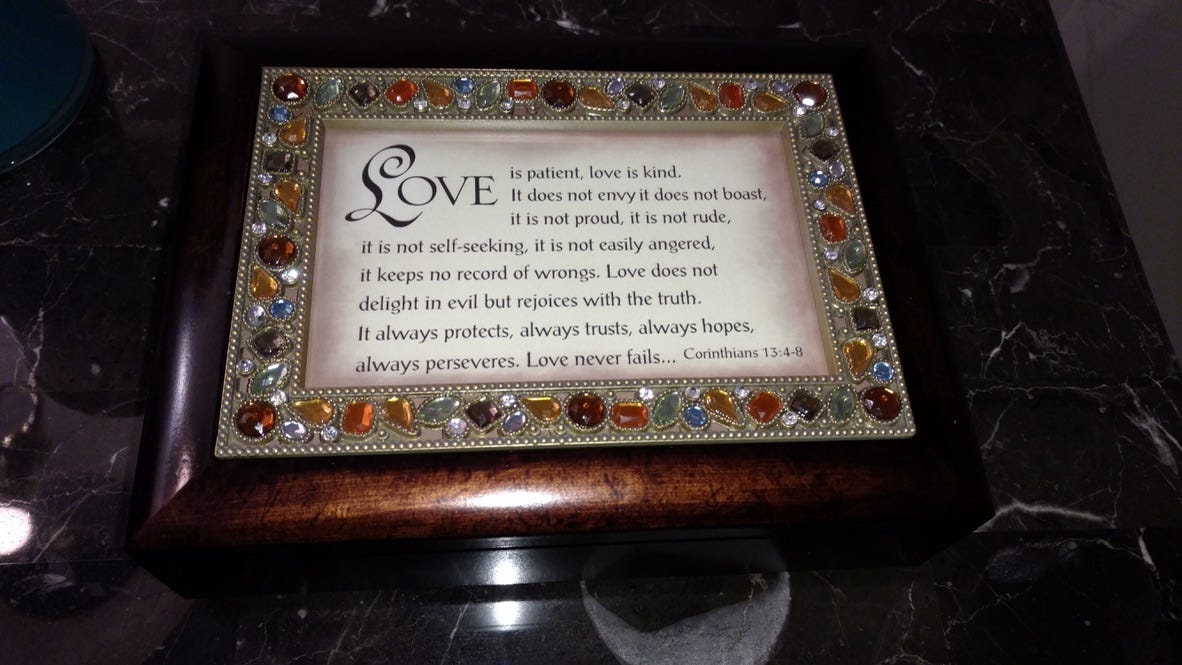
The gift was a jewelry box with a verse about love.
I had been slow to date after my divorce, and even slower to try a dating app, but a friend convinced me to give it a shot. I was terrified, imagining rapists and murderers. Serial killers.
Little did I know, there was another kind of danger; the kind where your love becomes entertainment in someone else’s game.
He was the second man I met. Calm. Kind. Smart. Funny. Gentle.
He wasn’t particularly attractive, a man in his late 40s with a little extra around the middle, thinning hair, and a wardrobe straight out of the 1980s. He had a middle-aged dad bod, and that was perfectly fine with me. He certainly wasn’t the charming, center-of-attention type I associated with narcissism.
He told me he loved me within weeks. He’d never met anyone like me. After being in a 19-year destructive marriage, it felt pretty good to be valued, and honestly, it felt believable, although a little surreal. Love had happened that fast for other people, so why not us?
I later learned the term for this initial phase of lovebombing: fast-forwarding.
He said all the right things about relationships, values, parenting, careers, and the kind of future we both wanted. It felt like we had so much in common.
What I didn’t realize at the time was that he was studying me carefully.
He mirrored my values and interests, my dreams, and even my wounds and fears. The more he reflected pieces of myself back to me, the more convinced I became that I had finally found someone who fit me deeply.
But I wasn’t connecting with the real him. I was connecting with an image of myself reflected back to me. As a result, he felt comfortable, familiar, and safe.
I remember him telling me one evening on the phone how he had been outside throwing a football with his son in the front yard. He said they did this almost every night. He also knew that I had spent years deeply involved in my kids’ events, attending games, concerts, and organizing much of my life around their activities.
My nervous system logged a connection because his story fit what I valued: family involvement, engaged parenting, and shared priorities. Yet, in two years together, I never once saw him throw a football with his son or attend one of his daughter’s soccer matches.
The version of him I believed in had been built from stories, not reality. He carefully constructed my sense of compatibility with him through hundreds of conversations and small moments that made us seem deeply aligned.
Some of it was partial truths. Some of it was flat-out lies.
I eventually learned that he was actually in his 50s. He openly admitted lying about his age on dating apps, saying “everybody does it.” Most of his interests, values, and priorities were nothing like mine. Nothing. The compatibility I felt had not developed naturally. It had been built through selective disclosures and strategically shared similarities designed to convince me we wanted the same things. I was being fed a constructed version of intimacy built to create trust, closeness, and investment.
Bait on a hook.
We lived an hour apart when we met, so it was easy for him to manipulate my knowledge of him. He said he wanted to marry me, but what he really wanted was more access to me. He suggested I move closer to him so our families could gradually get used to each other. It made sense, so I did. I uprooted my children and moved. A decision I will forever regret.
After moving, we spent much more time together. I remember feeling increasingly confused by the gap between what I observed and what I had come to believe about him. The stories he had told me and the person I experienced did not align, but I kept trying to make them fit. I was experiencing something called cognitive dissonance: the discomfort that occurs when reality and belief no longer match.
Looking back, I can see that my instincts noticed the inconsistencies long before my conscious mind did. I remember feeling like I was living in a reality where everyone else knew something I didn’t. If you’ve ever seen the movie, The Truman Show, it felt like I was living my own version of it.
Gaslit and Devalued
Growing up with a narcissistic father, I had learned to people-please. I had spent a lifetime learning to override discomfort and explain away red flags. Second-guess myself.
So when the microaggressions started, I did what I had always done. The devaluation was bewildering and subtle. I thought I was imagining things. He treated me as if I were naive and incapable, financially, and as a parent. My professional knowledge was questioned despite his total lack of education in my career field. He dismissed my opinions and shrugged it off as “just joking” when I objected.
Then there were the comments about my body that seemed innocent, but stung.
Things like:
“Why don’t you let your fingernails grow out a little more like other women? Most women like pretty nails.”
One time, he gave me a new bottle of lotion and told me he’d never seen elbows as dry as mine. I didn’t think my elbows were dry at all, but he was being thoughtful, right?
Then there were the sexual comments comparing me to other women, implying that I was unusual or strange for my preferences, especially when my boundaries were being pushed.
He portrayed himself as a “mentor” who cared about me, loved me, and wanted what was best for me, all while subtly planting doubt and criticism in ways that left me confused and off balance.
He was a nonviolent predator playing a psychological game with his prey.
Instead of questioning him and questioning the experience I was having, I questioned myself. My abilities. My knowledge. memories. My parenting. My instincts.
Autism: The Part That Confused Me Even More
He was autistic. Undiagnosed, but autism was my professional specialty, and I recognized it immediately.
He had a teenage son who had been diagnosed with Asperger’s years earlier, before it was reclassified as autism, the same as my daughter. We bonded over that shared experience.
I learned early on that he wasn’t open to the idea that of being autistic himself, but I didn’t need him to accept or acknowledge it.
Ironically, my understanding of autism, both as a mom and as a professional, ended up keeping me STUCK in the relationship.
I tolerated, excused, or explained away many of his harmful behaviors by attributing them to difficulties with social skills, emotional blind spots, rigidity, communication challenges, or misunderstandings about the impact he had on others. All related to neurodivergence.
And to be fair, some things really were related to autism.
My confusion stemmed from the fact that both were true: some behaviors reflected autism, while others suggested something much darker.
He genuinely struggled to read social cues. He genuinely had sensory needs. He genuinely had rigid thinking patterns.
He also absolutely understood the impact he had on others. He reveled in it. Exploited it. Weaponized it.
That is not autism.
When I raised concerns about his friendships with other women, behaviors that violated my relationship boundaries, or situations that left me feeling unsafe or disrespected, I didn’t see manipulation in his dismissive responses.
I believed he was naive to social nuance. I believed he genuinely did not understand why his behavior hurt me.
I didn’t consider that he might fully understand the impact of his behavior with other women, or the pain I experienced from being dismissed and devalued. I certainly didn’t realize that he was using all of us, individually, to diminish one other. Triangulation.
So, I kept explaining the relationship to myself through the lens of neurodiversity; different wiring and misunderstanding.
For many couples, that really is the explanation.
Neurodiverse relationships can cause confusion, conflict, hurt feelings, and strain. Partners may feel, communicate, solve problems, and experience sensations differently. What’s easy for one may be overwhelming for the other. What seems like resolution to one can seem critical or rejecting to another. Relationships can turn dysfunctional, but this usually results from unseen differences rather than deliberate harm.
Neurodiverse relationships can also be abusive. One partner might be indifferent to the other's suffering or, worse, take pleasure in controlling their pain, actions, decisions, or happiness. For this individual, control extends beyond managing executive dysfunction, sensory overload, anxiety, or routines; it centers on exerting power over another person.
These patterns are frequently linked to personality disorders, especially when they also involve exploitation, entitlement, manipulation, and lack of remorse. Conditions such as narcissistic personality disorder, antisocial personality disorder, and sometimes borderline personality disorder should be considered.
Regardless of the label, this is abuse.
And either partner in a neurodiverse relationship can be the abusive one.
Many people in confusing and painful relationships begin categorizing behaviors to seek a plausible explanation: Autism, stress, trauma. If a reason exists, perhaps the pain is unintentional, beyond their partner’s control, something they can’t help. Many find ways to endure painful relationships, just as I did.
No one wants to believe that their partner is aware of the harm they inflict, unbothered by it, or even deriving satisfaction from it.
Hope Was the Drug He Fed Me
In hindsight, it’s clear he did not truly love me. He needed me to believe he did, to remain hopeful that he loved me and that we still had a chance at happiness.
That was the drug he fed me, and it worked for a long time.
I continued interpreting his behavior as autism. Wrongly. His manipulation was not autism.
I questioned myself, and my instinct that something was very wrong, for far too long. I remained stuck trying to make sense of things, trying to be more accommodating, and to become a better partner.
All while tolerating increasingly harmful behavior.
When You Stop Trusting Yourself
One of the clearest warning signs in an abusive relationship is when you begin questioning your own reality.
Because once you stop trusting yourself, you become easier to control.
I grew up learning to fawn, people-please, minimize myself, and keep the peace at my own expense. Self-doubt felt normal to me.
Not everyone has a childhood like mine, though. Abusive, exploitative people can con anyone. They are often charming, attentive, and patient. They study people and learn what makes someone feel special, safe, needed, chosen, or understood.
Sometimes old wounds make people more vulnerable. Sometimes it’s loneliness, hope, and even love.
The problem is not trusting someone. It’s that someone used trust as a weapon.
Borrowing Trust From People Who Could See What I Couldn’t
So, when we’re struggling to know what to believe, and we don’t know if we can trust ourselves, we have to turn to our safe people; the ones who have consistently had our best interests at heart over the course of time.
My closest friends and family were my trusted circle, my grounding force. They knew me before him and saw me getting lost in that relationship. When I lost trust in my own instincts, they became my litmus test. They echoed my suspicions even when I tried to ignore them.
One of the last times I forgave him and went back to him, one of my best friends, frustrated and speaking very bluntly, told me I was acting “desperate and pathetic.” Her delivery was not soft, and I am grateful for that. It stung - a lot - but she was right, and it was exactly what I needed to hear.
However, I still didn’t leave him.
Not yet.
The Tipping Point
There were dozens of moments and arguments when I promised myself I was done. For two years, I got pulled back in by love bombing, apologies, hope, guilt, confusion, or the belief that if I could just explain myself differently, maybe things would change.
The tipping point for me was when he made a decision that endangered me physically, and then was indignant when I became upset. He was enraged and insulted that I would criticize him. There was not an ounce of care or concern for my well-being.
That was finally it. I realized I didn’t matter to him and never had. I had envisioned us growing old together, but now I saw myself battling old age and illness while he continued living his best life, completely ignoring me.
I walked away and never looked back. I completely cut him out of my life.
That relationship transformed my life. It was the start of my full comprehension of the narcissistic abuse cycle. It also marked the beginning of understanding something I now help others decipher:
Autism and narcissism absolutely can co-exist within the same person.
Relationships involving autism, narcissism, or both are rarely simple. They are complex, nuanced, and often deeply confusing.
Autism is a neurotype, rooted in genetics passed through generations. It shapes how people think, feel, perceive, communicate, and experience the world.
Narcissism is about character, personality structure, power, and control. Narcissistic abuse involves the use of manipulation, control, exploitation, or harm in pursuit of power, validation, attention, or personal gain.
Autistic individuals are not inherently abusive, but autism can absolutely complicate narcissistic abuse.
It can blur the lines and make harmful behavior harder to interpret. It can keep partners stuck trying to answer the question:
“Is this autism?”
The more important question is:
“Am I being harmed?”
What I Want You To Learn From My Mistakes
You do not need proof to trust your own experience or take your confusion seriously.
You do not need to know whether behavior is intentional before acknowledging that it is harming you.
Pay attention when your reality starts shrinking and when you stop recognizing yourself.
Pay attention when you keep explaining away behavior that leaves you confused, small, chronically anxious, or disconnected from yourself.
Your nervous system notices danger long before your mind catches up.
Do not try to figure this out alone. Talk to trusted people who knew you before the relationship. Ask them what they are seeing. Let them help you reality-check what has become confusing.
If you suspect autism, narcissism, or both, find support from professionals who understand both.
Because clarity matters.
If you are stuck in the same sorting process I was, trying to determine whether you are experiencing neurodiversity, abuse, personality pathology, or some complicated combination of them, I created a course specifically for that question.
Originally published on JodiCarlton.com. You can read the original article here:
Tell me about your own experiences.
This is so validating. I am looking forward to taking your course. I am currently trying to get physical separation from this man, financial stability, and rebuild my sanity and my life. Pray...I may be less than two weeks away from him finally moving out.
Master manipulators are the hard kind of abusers to recognize.
You know when someone punches you in the face, but the sneaky kind of abuse can be worse because it is harder to recognize.
I learned to trust my own intuition, and to remember no other person is my higher power.