


How a Child’s Autism Diagnosis Reshaped Their Marriage Jodi Carlton, MEd, LLC Jodi Carlton, MEd

Neurodiverse Relationship Expert
Jodi Carlton, MEd
February 24, 2026
conflict, connection, diagnosis, expectations
YOUR Neurodiverse Relationship Podcast
Host: Jodi Carlton
Season 5, Episode 17
Guests: Jeremy and Charity Rochford
In this episode, I sit down with Jeremy and Charity, a couple married for over 20 years, who share their journey of discovering neurodivergence in their children—and eventually in Jeremy himself.
Like many families, their story began not with a marital crisis, but with a preschool evaluation. What followed was a cascade of questions, shifting beliefs, and ultimately a reframing of what autism actually means. Jeremy candidly describes how his understanding of autism was frozen in a 1980s narrative shaped by Rain Man and stigma. Charity shares how becoming a parent softened her lens and allowed her to reinterpret behaviors that once felt frustrating as sensory overwhelm and autistic burnout.
What makes their story powerful is not that neurodivergence disappeared as a challenge. It didn’t. Instead, they developed systems. They experimented with accommodations. They adjusted expectations. They chose mutual respect over resentment.
You’ll hear us talk about:
Why autism and ADHD don’t excuse behavior but do explain it
The difference between accommodating someone and losing yourself
Why both partners “pulling the rope” matters
How unspoken marital expectations create friction
The importance of building a “marriage system” instead of blaming each other
And what it looks like when life doesn’t match the picture you originally imagined
This conversation reflects something I emphasize often: neurodivergence itself is rarely the core problem in a relationship. Misalignment, unwillingness, trauma history, and lack of mutual regard are far more predictive of breakdown than brain wiring alone.
Jeremy and Charity demonstrate that when there is willingness, motivation, and respect, a neurodiverse relationship can not only work—it can grow stronger because of the clarity that comes with understanding.
Season 5 Introduction
This is a lightly edited transcript from Season Five of Your Neurodiverse Relationship Podcast. Grammar and formatting have been corrected for clarity. Meaning and intent remain unchanged.
Jodi:
Hello, and welcome to Season Five of the Your Neurodiverse Relationship Podcast. I’m Jodi Carlton, your host and a neurodiverse relationship expert. Like so many of you, I’ve been on my own journey of discovering and understanding neurodiversity — both personally, with my family members and even myself, and professionally, as a therapist and now a relationship coach to people around the world.
I’m often asked: can neurodiverse partner relationships actually work? And the answer is absolutely they can. Just like any relationship, there are core variables that influence whether or not you’ll thrive as a couple. Neurodiverse relationships are no different — they just have the added layer of one or both partners being neurodivergent. This season, I’ve got a lineup of couples and partners who are in neurodiverse relationships that are working. They get real and personal with me about the challenges they’ve faced and how they’ve overcome them. Let’s get started.
Meet Jeremy & Charity
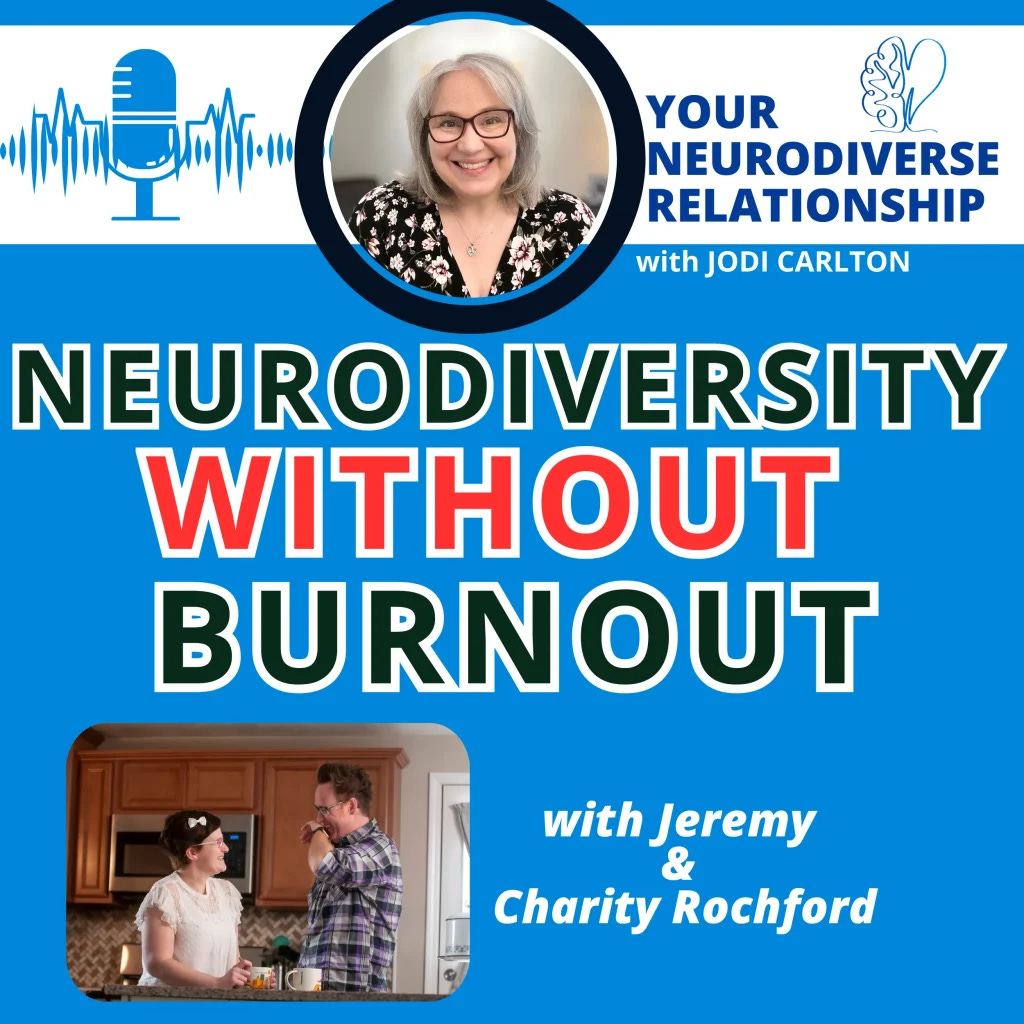
Jeremy and Charity Rochford—known as Team Rochford—are certified life coaches and co-founders of NeuroFam, where they specialize in coaching for neurodiverse couples, parents, and families. Married for 25 years and raising two autistic children, they blend professional expertise (Jeremy has a BA in Communication Studies; Charity a BA in Psychology) with lived experience to deliver a truly balanced perspective.
NeuroFam’s coaching is forward-focused and results-based—helping families create practical systems, reduce resentment, and build relationships that thrive. Jeremy works primarily with autistic/ADHD men, fathers, and young adults, while Charity supports neurotypical partners, mothers, and women navigating ND/NT family dynamics.
Jodi:
All right, today I’ve got Jeremy and Charity here with me today, and I’m really excited to have the two of you on the show because you are a neurodiverse couple.
You have your own podcast, you’re coaches, and you’re making it work. So that’s what this whole series is about. Let’s just start with you introducing yourself to our viewers and listeners.
Charity:
So, I am Charity Rochford. I am wife and mom of the house, and as we will get into it, I’m the odd man out. I’m the neurotypical. And we have two kids. So we’ll get into that as well, but yes, I’m the—
Jeremy:
I’m Jeremy, probably the most autistic of the group, kind of the bloodline that started a lot of this, where both kids are on the spectrum. We run NeuroFam, which is a coaching practice, and we’ve got the podcast.
I’ve got my bachelor’s in communication, and so I kind of came to the conclusion that instead of using public relations practices to help companies sound better talking to each other, let’s help couples actually start to sound better in their communication. And so that’s a very quick snapshot of who we are. I’m the dad.
Jodi:
Yeah. Obviously, this will be in our show notes, but could you go ahead and tell folks your website and the name of your podcast?
Jeremy:
So our website is ourneurofam.com. The podcast is Neuro FM, which you can also find at neurofm.com. And the goal of the podcast is to be the least depressing neurodivergent podcast in the world.
We found when we got into this space, not just with our diagnosis but trying to help others, that there can be a lot of darkness around this, a stigma, whether it’s autism or ADHD. And we found that it’s actually freeing to know that we’re on the spectrum because it explains so many behaviors.
And so we want to bring that side of the reality to the journey. We want to bring the positivity because you hear a lot of the negative and the doomsday shame. And it’s like our life has gotten exponentially better since each diagnosis occurred.
So the whole goal of the podcast is to kind of give that voice some amplification and to say marriages don’t have to end. You weren’t duped. There is a way toward happiness and joy. It might look different than you expected, but what journey doesn’t?
Jodi:
Yeah. That’s really one of the reasons why I’m doing this whole series this season of my podcast, because there is a lot of focus on the challenges. There are so many myths out there about it just not being possible.
I see people on my YouTube channel saying, “Just run, run. If you know, don’t stay in a relationship.” And I’m like, hold on. Neurodiversity is only one layer of who we are. There are neurodiverse couples who are misaligned just like neurotypical couples can be misaligned.
And there are other dysfunctional things and traits that can prevent a neurodiverse relationship from working, but the neurodivergence itself is rarely the problem. So I cannot wait to hear what you guys have to say. And that’s what this whole season’s about.
I want to circle back to what you just said about instead of helping companies learn how to communicate, let’s help couples.
I actually refer to couples as a company sometimes. I’m like, think about your partner as your co-founder. Would you talk to your co-founder like that? Even in dating, I’m like, look for somebody you’re willing to trust your company with and look for that person that aligns with you. So anyway, I just wanted to share that.
Jeremy:
We are totally aligned on this conversation.
Jodi:
Awesome. We’re already vibing then. So let’s just jump right in. Where do you want to start and what message would you like to share?
Charity:
I guess we should add in that we have been married 20 years. We dated four years before that, so we’ve been together a while.
Jeremy:
And then the neurodiversity part, the neurodivergence probably entered about five years ago, first with the kids, which then started a multitude of questions, which led to answers, which led to more questions, which led to more answers, which I think finally got us to a place of understanding.
And kind of like you said, neurodivergence isn’t quite the problem, but it might be something that makes solving the problem more challenging.
Jodi:
Yes, absolutely.
Jeremy:
From our coaching standpoint, autism and ADHD don’t excuse the behavior, but they explain it. And if we can at least understand the why, we can then ask what’s the best direction to solve the what.
Jodi:
Yes. Oh my gosh, you guys, we are so aligned because I think I’ve said those exact words before. I’m constantly taking my clients through the layers of why. Why is that? And why is that? And why is that?
Something you just said is also such a common pattern. It starts with the kids. The kids get identified as, “Something different’s going on here.” Or the school system says, “What’s happening here?”
And then they get identified as neurodivergent in some way, whether it’s ADHD or autism or sensory processing or dyslexia, or just one of those things. And then the parents—or I’ve even had grandparents come to me in their seventies saying, “Okay, my granddaughter got diagnosed, and that’s how it was in my family too.”
I don’t even know that we have a neurotypical representative in the family. I don’t think that person exists.
So just tell me more about that journey for you guys.
When the Diagnosis Begins with the Kids
Charity:
Yeah, so ours was identified by our son’s preschool program.
It was a long, kind of not quite clear process, right? Because they didn’t want to come out and say, “Hey, we think this about your kid.”
So it was, “You should probably have your child evaluated.” So we had a behavioral therapist come in and a behavioral specialist who did therapy as well come in and observe our son in preschool and say, “Okay, we have sensory issues, so we’ll get a sensory box, blah, blah, blah.”
And the director was like, “Yeah, no, that’s not it. You’re going to have to go back in and get some more.”
So then we got on the waitlist. We were figuring maybe ADHD. That would make sense to us. He was the only boy we had, so Sunday school teachers would just say, “Oh, he’s all boy. Here, you can have him back.” So we just figured that was what all boy was like. We didn’t know any different.
Charity:
So, in our months of waiting, I had actually met with a friend who’s a special education teacher while we were preparing for our full child psychiatrist evaluation process.
And for her to help kind of walk me through what I was seeing—I’m going to need to know ahead—we’d gotten our initial first step of questionnaires.
And just through the conversation with her, she planted the seed of like, “Yeah, it might be autism.” I was able to see it through her and see it in a very positive light because I was a psychology major. To me, it was all just, “Oh, okay, this is a new interesting thing that I should learn more about and be prepared and figure out how to help.”
That’s just my thing. I’m the helper in the family, right?
Jeremy was not quite as positive right away.
Jeremy:
Slow to adopt the belief, the understanding.
Jodi:
Can I jump in and ask you, Jeremy, from your perspective—because I know that is a thing for a lot of people—what was going through your mind? What was part of that slow process?
Updating the 1980s Autism Narrative
Jeremy:
Being a child of the 80s, at least from my perspective, with a lot of these things you grow up with, you kind of timestamp them when you first learn about them.
So when I hear autism, I think Rain Man. I think all these things from the 80s. I think mental deficiency, not mental difference.
And so that was my deeply held belief that hadn’t needed to be challenged until then.
So my default was, wait a minute, here are all these negative things. I learned about it when I was going through school. It must still be the same.
And so I think for me, that was where a lot of hesitancy was—hoping that there wasn’t an autism diagnosis because I knew, in 1980s autism diagnosis—
Jodi:
That’s what you were picturing for the future for your son.
Jeremy:
Exactly.
And so it wasn’t until Charity really brought me out of my comfort zone to challenge those beliefs of, “Wow. Okay, wait—that person’s autistic? They seem so normal. That person’s autistic? They’re hilarious. I thought autistics couldn’t communicate. What’s going on here?”
Right? And kind of bring me along to what autism is in the 2020s, not the 1980s.
That’s where my hesitancy came from. It was a 40-year delay of understanding and not paying attention to the research that we have now.
Jodi:
I think that’s such a valuable thing that you’re sharing because a lot of times it’s a partner who starts to realize, “This is neurodivergence. This is autism.” And then when they bring it to their spouse, there’s that heels digging in and, “Whoa, that is not what I am.”
Because that definition of what autism is—I know my generation too—my first exposure to the word was Rain Man. So that narrative has never been updated. It’s never really had a reason to be.
I’m working with a couple right now. She told me on the side, “He still doesn’t like it when you say autism.” And I’m like, “Okay, okay, okay. Thanks for letting me know.”
It is a process.
I’ve been working with a man whose one son had been diagnosed with Asperger’s back in the day, and I clearly saw that the other son was autistic—and the dad too. But when I brought that to him, he’s like, “Oh no.” And it was because they were like three different groupings of traits.
So to him, that one grouping—he accepted that his one son was autistic, Asperger’s autistic—but not him and not his other child. But they very much were.
So I think that’s very relevant.
Jeremy:
Well, I think it’s a really good segue, honestly, into how we discovered our daughter was on the spectrum because a lot of the questions we were going through to prepare for the test—they kind of give you this questionnaire of, “Do you recognize these things in your child?” to kind of give the psychiatrists a heads-up.
Charity:
“How often do they do this? How often do they do that?”
Jeremy:
Yeah.
Charity:
The classics are like, “How often do they line up toys?” And then the examples are all very boy-driven, like lining up trucks and cars.
But as we went through, there were some traits in there where we’d be like, “Oh, Jonathan doesn’t do that, but Corinne does that all the time. Maybe we should get her evaluated for something.”
And I should add in—Jonathan is diagnosed autism level two plus ADHD. His was the most evident to society, so that’s why his got picked up first.
And then, yes, as we were going through the evaluation and looking at things and being like, “Oh wow, that sounds like our daughter,” attention kind of focused on him for a little while. And then when we had the brain space to look more—
I was doing a lot of watching videos, right? That’s one of the ways that I take in things and process them really well, is to have real-world examples. So watching a lot of Tony Attwood videos—
Jeremy:
And that’s going to lead us to the next part of the story.
As Dr. Attwood was doing a really great job explaining how women tend to mask better and that’s why it’s so hard to diagnose, and you may get two of the five but you don’t get the extra—
You kept sending me these videos about these middle-aged New Zealand guys or these middle-aged Australian guys who are on the spectrum.
And my first response was, “This is great, but I think they’re a little old for our daughter. I don’t know if they’ll resonate.”
Which was your very nice, polite, covert way of saying, “We’re chasing the why, and we’re probably going to end at you.”
And I just wasn’t getting it.
Jodi:
You weren’t getting the subtle cues at all.
Jeremy:
I was becoming more open to the reality because once Jonathan got diagnosed, it was very much a fighting, “This isn’t going to change anything.”
“Do We Have to Tell Anyone?”
Charity:
And you did slowly go into it because you were like, “Okay, so it’s a thing, but do we have to tell anybody?”
Jodi:
What did that mean to you, Jeremy?
Jeremy:
Well, again, going back to the stigma, there’s such a close association with other mental deficiencies.
This was my first true experience.
And so it begat all the questions of, “Will people look at him differently? Will people have different expectations for him?”
Yes, we can control how we react to it internally and the narrative we create for him. But if we take that beyond our control, how much harder are we going to have to work if we build up this belief of what it can be for him and then you have some ignorant person just destroy that?
Now it’s like all that work we did is undone by someone’s ignorance or by a clinician who doesn’t fully understand, or a teacher who doesn’t understand or doesn’t care to understand.
So for me, it was more protective of, “This is our reality. How can we build a foundation that’s strong enough that’s not going to be wrecked by an outside influence?”
That was my greatest concern of sharing.
And then all of the perceived stupid questions that would follow, and trying to always have to defend my son as a label rather than a person.
Jodi:
And clearly you’ve gone from that to now you have a podcast. So that’s quite a journey.
I completely relate to that one as well because I’m also out here now trying to really spread the awareness and the education and really shift the paradigm of what we understand about what neurodiversity and autism is.
When Compassion Replaces Frustration
Jodi:
Okay, so talk me through—you’re learning, you’re starting to realize, you’re recognizing this in your son, you’re seeing maybe your daughter, Charity’s starting to see maybe it’s Jeremy too—and how is this affecting the two of you as a couple?
Charity:
For me, I feel like I kind of got lucky in that as a mom, you have this automatic internal compassion for your children and all the challenges they go through.
So when I would see our son being challenged by certain things, or our daughter struggling through something, that would change me. It made me feel the same for Jeremy.
So instead of things that had previously been like, “Oh, come on, get it together. You’re an adult.” Like when he would get angry offhand, what felt like out of the blue—now we know that it was building, building, building, and then he hits autistic burnout or just having a meltdown. Like a grown man meltdown, right?
Jodi:
Yeah, sensory overload. The spoons are gone.
Charity:
Right.
Jeremy:
Regularly. Mine went to eleven.
Charity:
Because through the years, there were all these other reasons for all of those things, right? Like his sensory issues with loud noises.
He had always just been like, “Well, I’m the only one who cares about my ear health.” So it was always like, “Okay, you’re just making a fight. You’re just picking a fight. You don’t care about your ear health more than anybody else.”
But coming forward and getting to see it through the kids—like, “Oh my gosh, Jonathan is really affected by loud noises that he doesn’t make.”
Jodi:
Key differentiator there.
Charity:
So getting to look at that and see, “Oh, that’s really stressful for him. That’s a real challenge for him.”
Instead of seeing it through the way that I had for 15-plus years of, “Oh, he’s just being too much,” now it’s, “Oh my gosh, this is a sensory thing.”
This has never been identified as a sensory thing. I can have compassion for that, and my response comes from a completely different place.
And because of seeing it in the kids—and my automatic reaction is compassion for the children and what they’re going through—it made it so much easier for me to see things in that way with Jeremy.
Personal Responsibility and Growth
Jeremy:
And from my perspective, this might seem irrelevant and random, but it lays the foundation for the answer.
About 20 or so years ago, I went on a weight loss journey where I lost 200 pounds without surgery.
This was late 90s, early 2000s. So it’s not like you could just Google, “How do you lose weight?” You had to figure it out.
Charity:
There was no Biggest Loser.
Jeremy:
Yeah.
And surgery wasn’t an option because my father was very much of the mindset that it’s not a lack of surgery in your life that’s causing you to be overweight. So adding surgery to your life isn’t going to solve it.
So I kind of devised a plan of, “This is what I need to do to lose weight.” I lost 200 pounds and kept it off since then.
And I brought that reality into the autism of, “Okay, inherently you don’t come factory-installed with executive function.”
We know that.
So if I need to be empathetic and I don’t have empathy, what do I need to do to learn empathy?
If I lack theory of mind and I need theory of mind, what do I need to do to strengthen my theory of mind?
And I started looking at the executive function things from the mental aspect almost as a physical aspect of, “Okay, I have weak arms. I need to do arm exercises.”
Okay, I lack theory of mind. What can I do to better understand theory of mind?
Apply it in my own terms so that I benefit from it, but so do those around me.
And so in the same way where Charity will feel that she got lucky because she has this compassion, nurturing understanding of the kids, I feel like I got lucky to have Charity to help me find that balance of accommodation while I’m striving to advocate for myself to be better.
As competent and reliable as possible.
And not to sit back and go, “Well, I wasn’t born with these things, so you just kind of have to deal.”
In the same way, I didn’t want to stay overweight, so I had to figure out how to change that.
I didn’t want to be the husband or the father who wasn’t able to participate and meet these expectations that society deemed as normal.
So it was the drive of going, “What do I need to do to operate in this world that’s not designed for me?”
All the while Charity’s running alongside of me saying, “Yes, we’re striving, but let’s take the accommodations where we can make them.”
So things like if noise is an issue, what type of headphones?
Well, headphones don’t work because they press on my glasses.
Okay, well are there noise-canceling earbuds?
Yes, but only certain ones, because some create a suction, which is another sensory issue.
But having the patience to go through five to ten different pairs until we finally got the right one, and having that balance of her accommodating that experience while I’m driving to improve the experience.
So that way, with the earbuds, I can still be present.
I can still be in the noisy situation my son is creating without being dysregulated myself and lashing out at him because I need that sensory protection.
As an adult, I was smarter than the situation and found a way to figure out the situation so our son can be a kid, but I can also be involved.
Jodi:
Even using that systematic logic to figure out the accommodation.
Charity, I want to hear from you. I have a question for you about accommodation, but I want to respond to what you’re saying because I find it fascinating that those of us who are in this space of figuring this out—and even working with other people—are coming to so many similar conclusions and even using some of the same language without ever having met each other.
Because I use the software and hardware analogy a lot. I talk about the hardware you’re born with and then the software that’s installed, and then needing a software upgrade or figuring out what you need.
One of my more popular podcast episodes was with David Glick, who is autistic and also a therapist. The name of the podcast was “You Need an Updated Software,” because he was talking about that.
And then here you are talking about it too.
I oftentimes use the analogy that all three of us are wearing glasses right now. We have this hardware—our eyes are not seeing effectively.
Do we just go around life going, “I can’t see very well, but you need to accommodate that”?
Or do we go to the eye doctor and get ourselves some glasses?
It takes the shame out of it because people feel so much shame when they say, “I was born this way. There’s nothing I can do about it.”
It’s like, well hold on. You were born this way, but is there nothing you can do about it?
I think there probably is something you can do about it.
So I just wanted to say it’s really cool to me that we’re all kind of understanding it in this similar way.
Charity, as far as accommodation goes—one of the things that comes up a lot in my Facebook group (I have about 2,600 members, both neurodivergent and neurotypical men and women in there, and we don’t allow any kind of bashing of any neurotype)—is resentment.
This resentment of neurotypical partners: “Why do I have to be the one to accommodate?”
I would love to hear you speak to that.
Accommodation Without Resentment
Charity:
That’s a hard question. Why do we have to do it?
Again, I feel like I’m lucky because I do have the kids first, right? So I see it through the eyes of my kids also. I can’t divorce that question from my children as well.
If I see them struggling and I can do something differently that is going to make it not as much of a challenge and help them be the them that I know they can be, why would I not do it?
We’ve developed some different processes now, but we had had our cars set up for different driving experiences.
When the kids were in the car with me, I’m theater carpool mom. We do carpool theater karaoke. It’s musicals at the top of our lungs, and there’s full kid autonomy and they can do whatever they want and be loud in my car.
Jeremy:
And we—
Charity:
In Jeremy’s car, our way of setting that up was to make it so his car was going to be more quiet.
Jodi:
So we’re at the museum in Jeremy’s car. We’re using our museum voices.
Jeremy:
Well, it started out with smart words.
So we would listen to some appropriate audiobooks and things like that because I didn’t want it to be such a lame experience. I didn’t want the ladies to have all the fun.
But I also knew that the kids screaming at the top of their lungs would feel like hell on earth.
So the original iteration before the earbuds and everything was smart words.
Let’s listen to podcasts and audiobooks that are educational but also kind of fun. Dad can control the volume.
And because they’re podcasts and audiobooks, you don’t expect them to be glaring at the top of the speaker.
Charity:
Dad controls what’s on. Dad controls the volume.
There’s no participation with the activity. It’s just the one sound that he’s expecting.
So that’s an example of an accommodation that really isn’t a negative to me in any way.
Yes, I’m doing things, but they’re not things that are hard to me.
They’re different, but I don’t feel “woe is me.”
I do have some sensory differences.
I was the first one to say years and years and years ago, “Hey, I don’t like certain things.”
We don’t generally vacation at the beach. Even our honeymoon, everyone else was like, “Oh, we’re going to Sandals or we’re going to this beach. Where are you guys going?”
And I was looking at him—he’s a ginger and me—and I’m thinking, no.
We like potatoes, so we agreed to go to Idaho.
Jeremy:
That being the response, it’s like, “Can I marry you twice?”
Because as a former fat kid, the idea of taking your shirt off at the beach—not awesome.
And then being someone who’s brutally ginger and Caucasian, I have two pigments. I have white or I have red. There is no tan for me.
But yeah, to your point—
Charity:
Yeah, I’ve kind of been making accommodations for my own sensory stuff.
There are just some smells that I cannot stand and I will avoid like the plague.
I do those things for myself to make me not completely grossed out.
I do that for me, and it’s not this super difficult thing. It’s just, okay, that’s just the next thing to do.
I don’t look at them negatively.
So anything that we do for you or the kids, it’s felt almost like a fun game of, “Oh, what new thing can we put into play that actually works?”
The visual clocks have been amazing.
We have clocks that are paired with our Amazon speakers that we use for a lot of things.
And I love Disney stuff, so I got Mickey Mouse ones.
Now when we’re prompting the kids for a transition, we’ll let them know, “Hey, you’ve got 20 more minutes to play.”
Instead of me having to remember to give them a prompt at 10 minutes and a prompt at 5 minutes, now we’ve gotten to the point where I can say, “Hey kids, you’ve got 20 more minutes. Set your timer.”
They’re learning that step themselves.
Now we’re getting to the point where I don’t even have to prompt them as much.
All I say is, “Okay, here’s 20 minutes.”
They audibly set their timer, and they can see how much time they have left.
Every time they think, “Oh, how much time do I have left?” they can look up at the clock and it shows them visually how many minutes they have.
And then it goes off to let them know when their time is up.
That’s another accommodation that we use in the house.
For me, it was just a bonus because I got Mickey Mouse clocks in the house.
Jodi:
But it makes everybody’s quality of life so much better.
Charity:
Right.
So I don’t see accommodating in our household as a negative.
Both Partners Pulling the Rope
Jeremy:
And I’d be interested to see as well, just to compare experiences from a clinical and professional standpoint.
The wives that we work with who feel the bitterness and the resentment—quite often that’s compounded by the autistic husband not really trying.
The autistic will say, “Well, why wouldn’t you make these accommodations? I’m the one with the clinical diagnosis.”
The ones who are able to get through that bitterness and resentment are the ones who see the genuine effort coming from their husband.
They can say, “Well, I’m doing this extra effort, but he’s seeing the effort I’m making and he’s making effort too.”
And I’ve found that the couples that really make it, both parties are pulling the rope.
Capacity, Willingness, and Motivation
Jodi:
I 100 percent agree with that.
This whole series is about what are those ingredients that can make a neurodiverse relationship work.
The three pillars that I say are necessary are capacity, willingness, and motivation.
Someone has to have the capacity, and if they don’t, they have to be willing to look at, “What kind of glasses can I put on? What kind of software can I upgrade?”
But if they’re not willing or motivated to do that, then now we have a misalignment problem.
I absolutely agree with you there.
But the other layer I’ll add is that a lot of times it’s other things that aren’t even related to neurodivergence.
Trauma history with other relationships, childhood trauma—there can be huge insecurity and a need to be validated and affirmed and reassured that you’re loved.
And then neurodiverse couples oftentimes communicate love in different ways.
One person is looking to be confirmed in one way, and the other person’s not doing that.
So there are a lot of layers there.
Again, it doesn’t go back to just the neurodiversity itself.
It’s the personality traits and the willingness and motivation.
I want to go back to what you were saying, Charity.
First of all, timers were a godsend in my household.
I raised my kids before a lot of this new technology came on the scene.
I went and got these little egg timers. They were like two dollars, and we had them everywhere—every room of the house, every car.
They were so effective and helpful because the kids could see that visual and get that transition period.
And I also wanted to say, I think what you said about being a mom is very relevant.
There are times when I hear conversations like, “Would you even want to be in a relationship with someone who’s autistic?”
I’m like, “Hey, you’re talking about my daughter.”
She’s a wonderful human being and fully capable of having self-awareness.
But I love what you said about accommodation.
There’s just this basic regard for who we are as human beings.
This is who you are. This is who I am. This is who our children are.
And because I love you, because I love them, what can we do to make everybody’s quality of life better?
Where it gets tricky is when people feel like, “I have to accommodate you at my own expense.”
Do you want to speak to that?
It’s Not the Person. It’s the System.
Jeremy:
Do you want to answer that, or do you want me to chime in?
Where a lot of this could be curbed is, did the two of you ever have a conversation pre-marriage of what an ideal marriage looks like?
Most honestly haven’t.
So what happens is spouse one will come in with expectations and spouse two will come in with different expectations. They’re never communicated, so off the bat they are prone to not meet each other’s expectations.
Then you throw in a differing neurotype who can’t understand their reaction to this disappointment, and then it just kind of spirals from there.
From our standpoint, working with the couples, we try to reset and go, “Okay.”
There’s a book called Thanks for the Feedback that talks about it’s not the communication that’s the issue. It’s the communication system that’s the issue.
Looking at marriage the same way, it’s not the people that’s the issue. It’s the marriage system.
Most parties never actually created a marriage system. So no wonder it doesn’t work.
Going back and establishing that system takes the pressure off the, “You’re wrong. No, I’m wrong. No, you’re wrong.”
No—the system’s wrong. Neither of us are wrong because we never actually established it.
We have found that that really helps make things better as it pertains to the resentment and the frustration and the entitlement and all of those things.
Jodi:
Yeah, I think so too.
I have an entire communication course and a model that I developed because of what you just said.
I even have this analogy—people who follow me have heard it a hundred thousand times—of this backpack, like a virtual backpack that you carry with you. Everything that’s in it makes you who you are at any given moment in time.
Those expectations, the values, your history—it’s all in there.
A lot of times people are just showing up and interacting without even being aware of the why.
Why do I feel hurt by what you just said?
Well, it’s because I expected you to say something different.
Why did I expect you to say something different?
Why did you have a different expectation?
It helps people unpack where those breakdowns are.
When Expectations Don’t Match Reality
Charity:
When you were talking, I was thinking about another piece to answer the last question a bit more on my side too.
There have been some accommodation pieces.
I love Disney. I worked in the Disney parks. I’m on a Disney podcast. I love Disney, and I love going down to the parks.
When I initially envisioned going down to the parks, it was as a family.
He would be like my podcast panel mates, right?
He would eventually love it as much as I do.
Looking at the way that they pose that question—well, what do you have to do? You’re giving up things essentially to accommodate them.
Part of accommodating Jeremy is knowing that that whole Disney park experience is too much for him.
It Just Looks Different
Now, it looks different.
I don’t not get to do it.
We’ve worked things out so that maybe it’s me and the kids, or me and the kids and my mom, or I’ll go with friends now. I’ll go on trips by myself.
I still get to really enjoy the things that I love.
It just looks differently.
Now we figured out that he actually doesn’t mind Disney cruising. It’s a different experience.
It is something that we get to do together as a family, and I still get to do some of those things.
Sometimes it just doesn’t look the way I imagined it would.
Jodi:
And that’s true of life though, isn’t it?
We imagine what life’s going to be, and then it definitely doesn’t always turn out that way.
Jeremy, what were you going to add?
Mutual Respect as the Foundation
Jeremy:
I think from the guy side too, being appreciative of that.
I’ve worked with a lot of guys who would respond very differently in that situation where, “I don’t like Disney, so why would we go to Disney? Let’s go to my special interests.”
And I go, “Why should she suffer because of something I don’t appreciate?”
Likewise, why would I diminish?
There are a lot of guys who’d be like, “Disney’s stupid. How old are you? Shouldn’t y’all be growing up?”
And it’s like, no.
She loves that.
In the same way, you could ask a grown man, “Why are you wearing another grown man’s jersey? That’s not you. You’re not playing for that team.”
If she’s not going to belittle my special interests—NASCAR or hockey or things like that—why would I belittle something that has deep emotional attachment to her childhood?
Closing Reflections
Jodi:
I think that’s such an important message, particularly for our autistic thinkers who sometimes have difficulty with theory of mind and recognizing that your point of view, your perspective, is really valid to you.
What I’m hearing from you both is that one of the fundamental ingredients is mutual respect and mutual regard.
Even though you are really different from me, and in a lot of ways I cannot relate to you at all, I still respect you and value you and recognize that your experience is just as valid for you as mine is for me.
I really think that’s one of the most fundamental ingredients of a healthy relationship, no matter the neurotype.
I want to thank you both.
This has been a delightful conversation.
Obviously, we could talk for hours and hours, so if you ever want to come back, please reach out to me. I’d love to talk to you again.
Charity:
Thank you.
Jeremy:
We’d love to.
Charity:
Yeah, this was great. Thank you.
Jodi:
That’s a wrap for today’s episode.
Be sure to subscribe or follow the podcast so you won’t miss any of these amazing interviews.
And as always, if you’re benefiting from and enjoying this podcast, please give us a review.
It really helps other people know that this podcast is beneficial and worth listening to.
Thanks for watching on YouTube or tuning into your favorite podcast platform.
Don’t forget to visit me online at jodicarlton.com for more resources.
I have assessment quizzes, educational articles, courses, and more.
If you have any questions, just reach out to my team at gethelp@jodicarlton.com.
Until next time.
The post How a Child’s Autism Diagnosis Reshaped Their Marriage first appeared on Jodi Carlton, MEd, LLC.