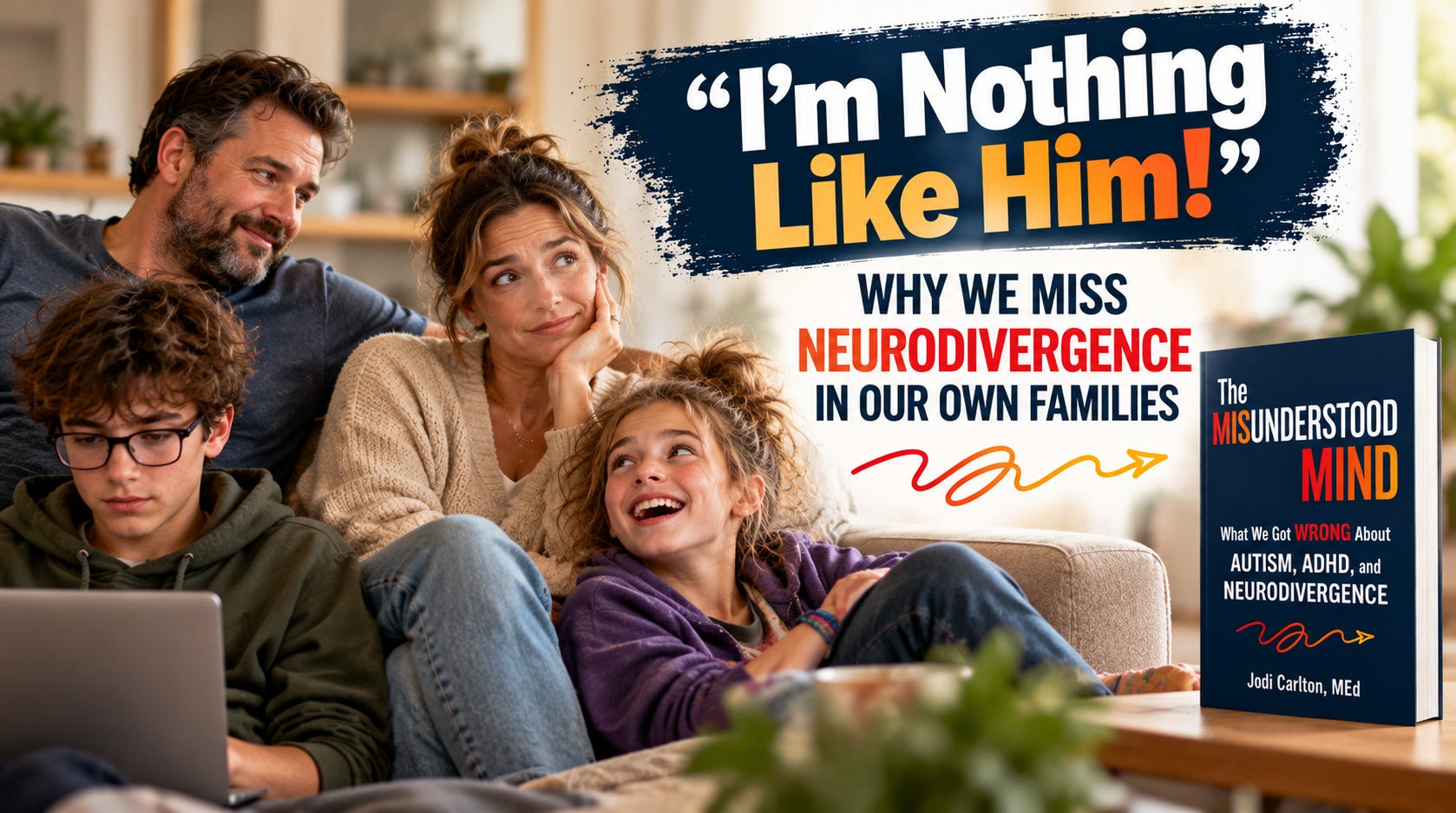
A familiar experience with autism or ADHD can sometimes make it harder to recognize neurodivergence in someone else—even ourselves.
A couple of weeks ago, I shared a story about my teenage neighbor who interviewed me for a scholarship essay.
He has a nonspeaking autistic brother, so autism has been part of his life for as long as he can remember.
But during our conversation, as I described some of the ways autism and ADHD show up in my own family, he suddenly stopped me.
“I think I have that.”
What struck me about that moment wasn’t simply that he was beginning to recognize something about himself.
It was that he’d grown up with autism in his family, yet had never considered that neurodivergence might look entirely different in someone like him.
And I’ve seen this same phenomenon countless times in my work with neurodiverse individuals, couples, and families.
“But I’m Nothing Like Him!”
Sometimes, one family member receives an autism or ADHD diagnosis, and suddenly everyone is learning about neurodivergence.
But their understanding is often centered on that person’s particular characteristics and challenges.
When I suggest that another family member might also be autistic or have ADHD, the response can be surprising.
Sometimes they’re curious.
Sometimes they’re genuinely shocked.
And sometimes they’re downright offended.
“I’m nothing like him!”
And you know what?
They’re often absolutely right.
They may have completely different personalities, abilities, challenges, and ways of navigating the world.
One may struggle significantly with social communication, while another is articulate, outgoing, and socially confident.
One may have substantial executive functioning challenges, while another is highly organized and successful.
One may experience significant sensory sensitivities, while another barely notices the same environmental stimuli.
Being neurodivergent means having patterns of traits that are different from the most commonly occurring traits, but it doesn’t mean neurodivergent individuals share the same experiences, behaviors, or challenges.
In fact, I’ve seen families where the very person who introduced everyone to neurodivergence becomes the reference point that prevents them from recognizing it in anyone else.
Including themselves.
What We Think We Know Can Get in the Way
This is one of the reasons I believe changing the narrative around neurodivergence is so important.
We don’t simply need more awareness of autism and ADHD.
We need a more accurate understanding of the many different ways they can manifest.
Because the assumptions we carry about neurodivergence don’t just influence whether we recognize it.
They influence how we interpret people’s behavior.
How we understand our children.
How we respond to our partners.
How teachers approach students.
And even how healthcare professionals recognize—or overlook—neurodivergence in their patients.
Sometimes, what we think we know is precisely what’s getting in the way of understanding.
And when our understanding changes, so does the way we respond to one another.
One Conversation Can Change More Than We Realize
I’ve expanded on this idea in a new article on my website, exploring how the stories we’ve been taught about autism, ADHD, and neurodivergence shape our relationships, our communities, and even our understanding of ourselves.
I also share why I believe changing the narrative doesn’t always require some enormous effort.
Sometimes it begins with a single conversation.
A question we hadn’t considered.
An assumption we’re willing to challenge.
Or a new way of understanding someone we’ve known our entire lives.
Read the Full Article: How Understanding Neurodivergence Can Change Lives—One Conversation at a Time →
Because greater understanding doesn’t just change how we see one another.
It changes how we connect with one another. 💛
Explore the complexities of neurodiversity and how much we’ve misunderstood it in my new book: